Happy Easter, And Nature Waits on No Man
Happy Easter!
I always think of early April as time when gardening really kicks off. Sure, I have been sowing seeds inside for almost two months, but now I can get my hands dirty outside! Just two days ago I planted Broad Beans, Tibetan Barley, Ethiopian Blue Tinge Wheat, and Kabuli Chick Peas. If I hadn’t run out of steam I would be also sowing my potatoes, peas, carrots, and transplanting out some of the early crops still in trays inside. It is hard to find the time to do it all!
Yesterday I spent the day cleaning out our big greenhouse (20 feet by 100 feet), and composting and preparing beds to plant. We winter our sheep in there and it was FULL of old bedding. I haul it all out to compost; it’s a massive job, but all the compost is worth it. Then I spread finished compost and mix it in, after loosening the soil with my subsoiler. The sheep really compact the soil in the greenhouse over the winter, but it’s worth the extra work because they fertilize the soil too, all winter long.
Seedy Saturdays are done for the year— at least where I live. We had our best year, and it is really great to meet so many of our growers and gardeners face to face. Tomorrow I am going to be at our regular Farmers Market here on Gabriola Island. If you’re on Gabe swing by and say hi!
We are hearing from a number of gardeners that they are planning on growing more this year because of the war in Iran. Regardless of where you stand on the war, food prices are going to go up in the coming months. It makes sense to offset this with good food grown at home. That said, “Nature waits on no man”, as the saying goes. Or woman. Or anybody. With some crops, you can plant them anytime, and they grow so fast, and are so hardy that you will get something. Kale comes to mind. Others, like peppers, tomatoes, leeks, and onions need a longer season to grow to produce or size up. And some things, like arugula or cilantro, just bolt right away if they are planted in the long days and heat of the summer.
That’s why farmers work so hard in the spring: there is a window to get things done, and if you miss it, too bad. I am sending out this quick reminder that the planting window for all spring crops is open! On the coast at least. Hold back on the warm weather stuff— the beans, squash, cukes, etc. That window is still firmly shut. Free shipping is continued until the end of April. Happy planting folks! I am off to plant some carrots!

Free Shipping, Tomatoes, and *The Best* Seed Starting Mix!
Hi Folks,
To start, for the rest of March we are offering free shipping on every order! Even for one or two packets, there is no charge for shipping, so if you have been hesitant because you only have a few types of seeds on your to-grow list, here is a good reason to order.
Also, this is nearly the time to start your tomatoes. If you have indoor lights, then I would start now. If you just have a sunny window to start your tomatoes, then I would wait a couple of more weeks because your seedlings might get a bit leggy for want of light. When tomato seeds sprout, they want to grow! We have a great collection of tomatoes at Sweet Rock that changes a little bit every year as we trial new varieties and discover new favourites. If you are looking for the perfect cherry tomato, we have several varieties, or a mix of them all in one packet.
We have other varieties to trellis, others that grow well in containers, some that grow like a squash, and some for slicing and sauce. There are several thousand varieties of tomatoes in the world, if you can believe it, and what we offer is a tiny, tiny slice of that pie, but every variety has been trialled and proven—to us— worthy of offering. I love growing tomatoes and would grow way more if we had the space and time to do so.
After my last post on seed starting, I have been asked to talk more about what a good seed starting mix is and how to make one, so here is my basic recipe, which is awesome! It will fill a large wheelbarrow. You can make more on a large tarp, or less as you choose.
I use a large white bucket as my measure; you can use something smaller, but keep ratios the same. Start with 2 buckets of peat moss. Mix in two handfuls (think of a handful as approx. 1 cup) of limestone, a handful of oyster shell, and a couple handfuls of fertilizer. (I use Gaia Green Organic 4-4-4). Mix it well, then add 1 bucket of coarse sand. Mix again. Finally, and most importantly, add 1 bucket of compost. If the compost is lumpy put it through a screen to break it up, or work it in with your hands or a shovel.
When this is all mixed it is ready to go, although I think it works even better if it can sit for a month or more. I store my potting soil in a large garbage can and scoop out what I need with a shovel or sturdy pot. The recipe is loosely based on Eliot Coleman’s recipe from his book, “The New Organic Grower”, which isn’t so new anymore.
Having a good seed starting mix is key for healthy plants. Most store-bought mixes are 95% peat moss, with a bit of perlite added, and just enough fertilizer to keep seedlings going for a couple of weeks. If you have ever had the experience of starting your seeds, and they come up fine but sort of languish after a little bit, this is why.
Until next time, “keep calm and sow on”.
Farm Update, Seed Starting Tips, and Avocados!
Hi Folks,
A couple of weeks ago I was going off to everyone about how we were going to have an early spring, and then of course, we were hit with 10 days of freezing weather and two bouts of snow. My poor avocados! Yes, this is true. But first some seed starting tips. Despite the sense of humour that Ma Nature has, spring is on the way, and if you have a bright sunny window— or even better a heat mat and an indoor grow light, you can start a host of cold hardy plants right now. Then when it does warm up, they will be ready to transplant into the garden.
I have been to four Seedy Saturday events so far this year and at every event I am told by someone how hard it is to start seeds. It is not hard, but there are a few things to know. First, if you are a beginner I recommend that you use store bought starting mix. It will cut down any potential problems with weeds and fungus’ from home made potting mixes. They aren’t the best, but they will work. Home made potting mixes can be outstanding, but they can also be vectors for disease and despair.
Second, when you plant your seeds, don’t plant them too deep. The general rule is to sow them about three times their diameter or length in the soil. Gently firm the soil to avoid air pockets.
Next (secret tip), when you water in your seeds, use warm water. Unlike some humans, plants don’t like cold water plunges. And place your seed tray in a warm, bright spot. Some seeds, like peppers, need up to 20 degrees celsius to sprout well. Even cold hardy plants like kale won’t sprout well below 15 degrees. They will, but slowly and resentfully. Light is good too because some seeds like lettuce and stinging nettles will sprout better with light.
What you can start right now with just a bright window and some warmth: spinach, lettuce, kale, broccoli, the mustards, celery, arugula, etc. If you have a light go ahead and start some peppers. They need a longer season to produce fruit, and if you start them now you can get massive harvests later on. Wait a bit for tomatoes. They grow so fast that they will be ready to go into the ground by mid-April, and it will still be too cold outside for them. If you have a greenhouse, well then… go for it!
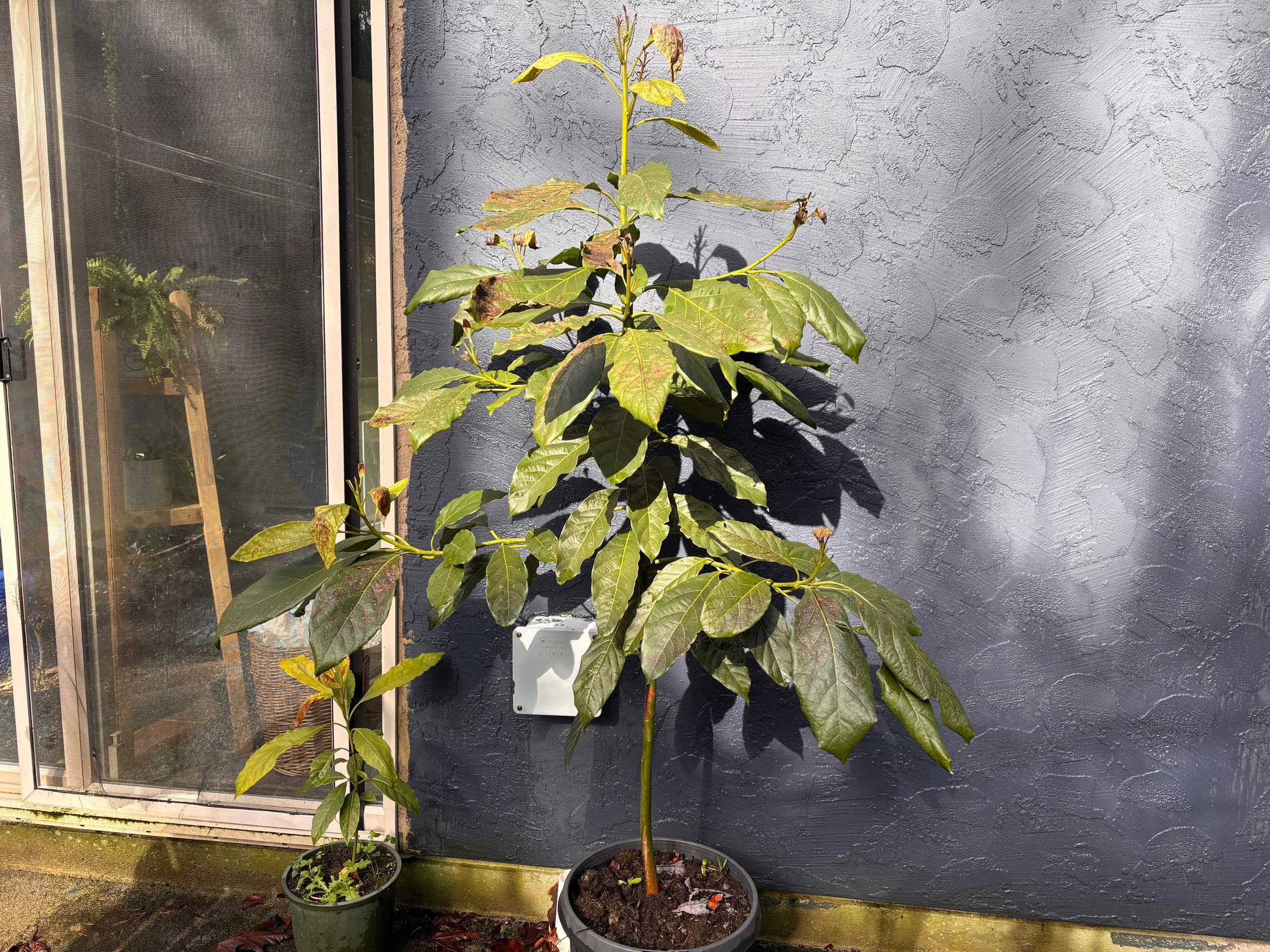
Lastly, I am on a quest to discover an avocado tree that will survive our winters and produce fruit. You are welcome to join me. I have started literally hundreds of avocados from seed in the search for the mutation that will allow one to survive and thrive. They have all died. Am I crazy? Below is a picture of two avocados that have survived this winter outside, completely unprotected with nothing more than a few burnt leaves. They endured temperatures down to -5 degrees celsius, two snowfalls, and a solid two weeks of below zero temperatures. I am pretty sure they are mad at me and are craving warmer temps, but look! The big one is two years old, and over 5 feet tall!
We all need projects that inspire us. This is mine. And bananas. But that’s another story. I hope you are inspired to start some seeds today, or soon, and grow some food. Everything in our “Greens” section is 10% off until March 10th!
Thank you,
Sal Dominelli
All About Onions!
Hey Folks,
I get asked all the time how to grow onions: Is it worth it, they’re so small, maybe I should just grow from sets, and more. The answer is YES! you should grow onions because its not that hard once you know a couple of tricks, and most of us use an onion pretty much every day when we cook. What better feeling than using onions you have grown in your own garden? Honestly, if they were really difficult to grow we probably wouldn’t have started cultivating them some ten-plus-thousands of years ago.
First, onions prefer a long growing season. That means that they have to be started early, because once the days get really long, around summer solstice, onions start to bulb out whether they are 6 inches tall, or 3 feet tall. That’s the way they are wired. Onions are photoperiodic, meaning they don’t develop their bulbs based on their size or amount of weeks they have been growing, but on amount of daylight, and when the days start to get really long they start to bulb. Period.
The time to start onions is now. I usually start mine in early February, and I grow big onions.
Here is what I do:
I fill a flat with good potting soil and pepper it with 200 or so seeds. You can use a six inch pot for smaller amounts. Cover with another 1/4” of potting soil and gently press down. Water well and place in a warm spot inside to sprout.
When they start to sprout, about a week to ten days later, place either in your brightest window, or if you have grow lights, under the lights. Water as needed. If they start to yellow at any point, they need fertilizer. Use an organic solution like fish fertilizer to help them out.
You’ll notice that after a few weeks they will get “leggy”. This is when we give them a haircut! Trim them to about 3”. in height. They will be fine. Eat the tops; they are yummy, similar to chives. Every couple of weeks give them a haircut if they get longer than 5-6”. What this does is stimulate more growth from below, and the shaft gets thicker which will lead to a bigger bulb down the road. (Secret Tip).
In late March or early April, plant them into a prepared bed 6” apart, in rows at least one foot apart. They need to be kept weeded, and watered regularly.
Troubleshooting
There are hundreds of varieties of onions (maybe more), and they are usually well-adapted to their place. This means that the variety is adapted to its day length as well. So if you’re growing a cool onion variety that’s been grown by the good people in Tenessee for 300 years has been and newly discovered by an enterprising seed explorer (these people exist), it won’t grow well up here in Canada.
This is common problem these days, with large seed companies buying seeds from who-knows-where and selling them everywhere. You don’t know what you’re going to get. Know your source!
Other than this, the biggest problems are: Not weeding. I get it. When they are small they look like thick grass and it can be tough to keep up with the weeding, but onions have shallow roots and don’t compete well with weeds. Which leads to watering. Onions need steady water. Not every day, but don’t let them get too dry.
Varieties
We have been growing onions for many years, and have found a couple of varieties that work well for our latitude and climate. Many of you are familiar with Newburg, our go-to winter onion for long storage. It has outstanding storage and flavour. We have also been growing Ailsa Craig for many years, but this is the first time we are offering out our seeds. We love this variety! If you have had trouble growing onions, try this out. It is super vigorous, and can grow up to 2 pounds in size, and we regularly grow bulbs of at least one pound. It will only keep until Christmas (more or less, depending on your storage. Onions need to be stored dry and cool, about 10 degrees celsius).
We also offer Chives, which can be started just like onions, but when you transplant them, to the garden don’t separate them. Just plant the clump. Trim as needed, and it’s a perennial, so it will come back every year, a little bigger each time. The flowers are pretty too. Finally, we have Leeks, which are planted exactly like onions and transplanted the same too. Harvest them starting in the fall when they are getting big, but they are best after they have had some frosts and they are sweeter.
That’s it folks! Honestly, if you follow these tips, you should grow awesome onions. I hope this helps. If you have made it this far, Congratulations! Take notice that all of our onion varieties are 15% off for the next two weeks. Until next time,
Happy growing,
Sweet Rock Farm Seeds
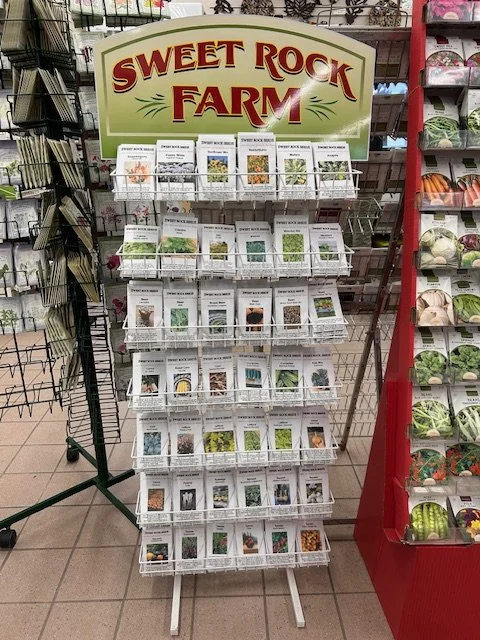
We’re all set up at Dinter’s Nursery in Duncan, so if you’re close by or passing through check it out. It’s a great place to shop!
Fall Greetings!
Hi Folks!
Another growing season has come and gone, and we have cleaned, weighed, and germinated seeds, and finally updated the website! As usual, the year was unpredictable with the challenges that we faced. I have named it, “The Year of the Mouse Invasion”, or, “The Mousepocalypse”.
They were everywhere in our fields and greenhouses. I have no idea why there was a sudden explosion in their population here, but they were an absolute menace to our crops. We lost every planting of peas we did. We first tried direct seeding— lost every single pea— then tried transplanting healthy seedlings and still lost everything. Twice! So you won’t see any pea seeds for sale this year. I had to give it up as I was running out of both seeds and time to grow a crop out. Ditto with zucchini.
Mice don’t usually eat tomato seedlings, but these ones did. It was really weird. When I planted my overwintered carrots into the ground to grow out the seeds, I knew the mice would attack, so I ringed my crop with a boatload of traps. I would catch several every night. I managed to get a harvest, but still lost almost half of my seed carrots.
Such is life on a farm. Hopefully this was a peak year and the natural predators of the mice will have grown to keep the population down for next year. Our dogs and cat sure killed a lot of mice! Chime, our cat, hardly ate any kibble all summer, so I guess that’s a win of sorts.
We a had lot of successes too. We have been growing Ailsa Craig onions for several years for our family to eat from harvest in August until January. We decided to grow out a seed crop this year because they are easy to grow, can get fantastically huge (up to 2 pounds!), and store reasonably well. Once they are done, we bring out the long keeper stalwart, Newburg, which we also grew out again this year.
Our bean crops grew really well, partly due to the weather, which was a great summer without the crazy highs or lows that stress plants out. I also kept them well weeded and watered, which helps. Once the beans had set and developed full sized bean pods though, the mice struck. This was very frustrating as I had nearly a 1/4 acre of beans and the mice were decimating the pods to get at the beans. I had to harvest earlier than I wanted and dry them away from the field, which is a lot more work, but at least I got a harvest!
I had the same problem with the squash. It was a great growing year but once the squash had sized up the mice showed up and chewed holes in the squash to get at the seeds inside. I still got a decent harvest but… grrr. Funny, they didn’t go for my hot peppers.
It could be that the mice population at my farm has grown because there is a large food source—seeds— close by. It’s ironic because I have always thought of my farm as a source of diversity that is beneficial. For example, I had an apiarist visit my property, and she was amazed at the number of bee species that were visiting my flowering crops. She said that she hadn’t seen this kind of pollinator diversity before, and thought that it was quite cool.
Obviously the diversity extends to large mice populations as well! Maybe in the grand scheme of things the mice are a good thing because it will attract and support populations of predatory birds like hawks and owls. If so, I hope they do a good job next year.
Aside from the mousepocalypse, the world does seem more uncertain these days, and as a farmer I encourage people to grow any amount of their food that they can, as it makes not only you a little more resilient, but makes the our entire food system a little more resilient too. For example, if you are able to grow much of your greens for several months of the year, it matters much less if the produce from the U.S. triples in price because of a weakening Canadian dollar.
A fellow I know and respect says that it is totally overwhelming to try and grow all of your own food. I agree! Instead, he says, start by growing one meal a week for you or your family. This is totally doable during the growing season. When you can do this, add in another meal or two. The goal is never to “do it all”, but to do some.
If you have limited space, a worthy goal is to try growing some of your culinary herbs. Many herbs are super tough and grow well in pots. Harvest when they are plentiful and dry them on a windowsill. Store them for winter use in a mason jar.
Above all, get used to failure! It is 100% a part of gardening and farming. But I plant so much I have many more successes. I am an apocaloptimist at heart.
Thanks for reading this and may you all have a wonderful Christmas and a bountiful year of growing with Sweet Rock Seeds!
Cheers,
Sal

Container Gardening, Free Shipping Extended, and More!
Hi Folks! Happy Spring! I know it’s not really Spring yet, but it sure feels like it today, with the sun shining and the temperature up to the mid-teens.
I have been getting a lot of questions about planting crops in containers these days. This is “Seedy Saturday” season, and I have been attending at least one every weekend since mid-January and will keep on until early April.
The quick and easy, highly simplified answer as to what you can plant in a pot is… anything! As long as the pot is big enough, you can plant anything in it. That being said, there are some garden plants that can easily be grown in a pot (I will list these in a minute), and some that are more difficult. Notice I didn’t say impossible, just difficult. I have met people who have very impressive gardens and everything from squash to carrots to tomatoes are container grown.
First the cons of container planting: It requires an investment in pots (obviously!), and some kind of soil medium to grow the plants in. And this can get expensive if you are growing in a lot of pots, or very large pots. Nevertheless, this is a more or less one time investment because in the following years the soil medium usually just needs topping up with compost. The other issue can be watering the pots. In the heat of the summer, you may need to water every day, and this can take a lot of time if you have a large container garden. A drip system on a timer might be in order then.
The positives of container gardening are several: If you live in a building with no access to land and just a balcony, or you live on a rock, you can still grow some food. This is huge! And you can grow a lot of food in a small space if you are organized. For example, if you have just six medium sized pots and a seed starting flat that you can put in a windowsill, you can be growing leafy greens outside while starting seeds inside to replace them right away once they are eaten. It will take time to work out the timing, but that is half the fun. Remember to add a good compost every few months when growing this intensively to add nutrients.
What I like about growing in containers is that they can be moved to a better location if you need to ripen off some tomatoes, or bring them inside to avoid frost, etc. Also, I really enjoy companion planting in pots. If like to fill a pot with a mish-mash of different plants and eat them as they crowd each other out. For example, I will fill a 12” pot with a few lettuces, some green onions, and some cilantro, and eat what is crowding out the others. Yum!
Here is a short list of what can be easily grown in pots: all leafy greens— lettuces, mustards, etc., herbs like dill and cilantro, green onions, and many smaller flowers. These next plants require bigger pots but can still be grown relatively easily. Peppers, Kale, beans (climbers will need support), and smaller, determinate tomatoes. Grow these tomatoes with a cage around them to catch the sprawling habit of them.
Lastly, your biggest pots should be reserved for the really big garden plants. Remember that these take up a lot of room above ground too! Squashes including zucchini and melons, the large indeterminate tomatoes that grow really tall, and sunflowers.
I hope this inspires a few of you to try some container growing this year— even if is growing some herbs on your deck. Our free shipping sale has been extended through March because, well, it’s going great! Happy planting to all. Shop Seeds at Sweet Rock Farm!

Free Shipping, Tariffs and Seeds, More
Greetings Folks! If you are in Canada then you are probably still covered in snow, but don’t get complacent; spring is just around the corner. If you live on the coast, as we do, you can be starting the hardiest of crops inside now, and getting them going so that they can be transplanted as soon as possible when the snow melts. This would be your greens like kale, lettuce, turnips, bok choys— the Asian greens in general are really hardy, mizuna, the mustards, etc.
For the rest of this month we are offering Free Shipping, to get you into the spirit of spring. And honestly, if you are tired of the snow, there is no better palliative than looking at seeds, planning the perfect garden in your mind, and dreaming of summer harvests of tomatoes, bunches of fresh basil, or the fragrance of a perfectly ripe sweet pepper.
Speaking of peppers and tomatoes, it is almost time to start them if you can do so inside and have some lights to give them a head start. It might seem a little excessive if you have never used indoor lights to start your seedlings, but it is a game changer for the home gardener. it really is. Peppers in particular benefit from the early start, as they are such slow growers when they are little. That extra few weeks inside gives you a lot more fruit, and an earlier harvest come summer.
Most of you must know about the changes down south and the tariffs that are looming. I hear a lot of fear porn in the media, but I don’t hear much talk about solutions. Yes, change is coming, and regardless of how you feel about it, you can make changes that will absolutely make a difference. How? That is easy. Buy local.
Whether you are buying a bottle of wine, or a packet of seeds, or a lift of lumber, buy a product that has been fully grown or made in Canada— at least as much as possible. That is the trick though. Knowing what your buying….
In the world of seeds— the only world I feel I’m qualified to really talk about— there are loads of companies that appear to be local but aren’t. Picture the website featuring “Alice and Dan”, two young farmers who grew up in the city and always knew they loved growing things, and finally got to move to the country and raise their children and now sell seeds for a living. By supporting them you are helping to support them and save the planet, or whatever.
Are they really growing these seeds themselves? Or are they buying them in bulk, wholesale online, and reselling them to you, the unaware buyer? Here’s the key: If they don’t say explicitly, “we are growing these seeds here, all of them, on our farm”, they probably aren’t.
Another example: West Coast Seeds is a local company, in the sense that they are based in Canada, but their product is not Canadian at all. They source their seeds from all over the world, but they don’t actually tell you that. You, the trusting buyer, assume their product is Canadian because they talk a lot about growing on the West Coast, they have a planting chart for local growers, and so on.
We are entering changing times for sure, and it can be a little scary, but on the positive side, like never before we are able to research, ask questions, and empower ourselves to make good choices— not just about seeds (which would be awesome!), but about all of our food and other commodities that we rely on.
We are never going to be self sufficient in avocados here in Canada, obviously, and maybe not in many things. But we can— and should— do way better than we are. Why not process our lumber here in Canada, instead of shipping it into the States and buying back finished lumber? We used to. We could also refine our oil here instead of shipping it south and buying back the finished products. And so much more.
Before I am accused of simplifying everything let me just say that yes, it is complicated, but not impossible. Start small, say, with seeds. Grow from there. End of rant.
All the best!
Your local, Canadian, crazy seed farmer
Sal Dominelli
Seasons Greetings, A farm Update, and More!
Seasons greetings to everyone from all of us at Sweet Rock Seeds. It has been a long time since I have last updated you folks about the farm and there is of course much to tell!
Our growing season this year was a learning experience for us. We had huge ambition this year, wanting to grow more seed than ever. We no longer grow for our local Farmer’s Market, wanting to focus just on growing the best seeds we can, and to that end we are all in. Except… as they say, “Nature bats last.” Normally, the East Coast of Vancouver Island is a premier seed growing area for dry-seeded crops like spinach, beets, all of the Brassicas, etc., not just in Canada., but in the world! This area rivals the best seed growing regions for dry-seeded crops on the planet. Why is it so good?
The East Coast of Vancouver Island usually has mild winters and dry summers, which are perfect growing conditions for certain crops that need to dry down their seeds in the heat of the summer and not get rained on, which can ruin the seed. For example, Kale can live through our winters and reliably dry down a crop of seeds in July and August. In much of the world the winters can be too cold, and the summers too hot, or too wet to grow the seeds out.
This year we had a rainy August, which was a disaster for some of our crops. We lost our entire onion seed crop. The seed heads, which were late to bloom because of our unusually cold, wet spring were in full flower, and the dampness let to a fungus that molded all of the flower heads. Our broccoli crop had a similar problem and was a total loss. Yet, we had large, beautiful broccolis just a month earlier. Oh well. These are the vagaries of seed growing, and we lost a few seed crops.
On the positive side, we had some great successes too. We had stellar harvests of squashes, corn (a sweet corn!), peas, and even the tomatoes did wonderfully. They seemed to appreciate the August weather. The wonderful thing about having a diverse farm is that something almost always thrives!
We have several new varieties on offer this year: Two new tomatoes great for both growing in pots and in the ground, a tasty and good-keeper winter squash, a funky and awesome cucumber, a new sweet corn, a fiery pepper for those who like the heat, and a couple of interesting herbs. You can check them out here if you like.
If you have a gardener in the family and are not sure what to get them, our gift card is a great idea. Easy to use, secure, and redeemable at any time.
In the spirit of Christmas we are offering a 15% discount on everything in the store until Christmas Day. We promise to ship all orders within a day of receiving them, but realistically with the postal strike just ending, I would’nt count on getting your seeds by Christmas. But— we don’t need to plant anything now. Spring is coming….
Thank you for continuing to support small-scale, local agriculture. Merry Christmas!