All About Onions!
Hey Folks,
I get asked all the time how to grow onions: Is it worth it, they’re so small, maybe I should just grow from sets, and more. The answer is YES! you should grow onions because its not that hard once you know a couple of tricks, and most of us use an onion pretty much every day when we cook. What better feeling than using onions you have grown in your own garden? Honestly, if they were really difficult to grow we probably wouldn’t have started cultivating them some ten-plus-thousands of years ago.
First, onions prefer a long growing season. That means that they have to be started early, because once the days get really long, around summer solstice, onions start to bulb out whether they are 6 inches tall, or 3 feet tall. That’s the way they are wired. Onions are photoperiodic, meaning they don’t develop their bulbs based on their size or amount of weeks they have been growing, but on amount of daylight, and when the days start to get really long they start to bulb. Period.
The time to start onions is now. I usually start mine in early February, and I grow big onions.
Here is what I do:
I fill a flat with good potting soil and pepper it with 200 or so seeds. You can use a six inch pot for smaller amounts. Cover with another 1/4” of potting soil and gently press down. Water well and place in a warm spot inside to sprout.
When they start to sprout, about a week to ten days later, place either in your brightest window, or if you have grow lights, under the lights. Water as needed. If they start to yellow at any point, they need fertilizer. Use an organic solution like fish fertilizer to help them out.
You’ll notice that after a few weeks they will get “leggy”. This is when we give them a haircut! Trim them to about 3”. in height. They will be fine. Eat the tops; they are yummy, similar to chives. Every couple of weeks give them a haircut if they get longer than 5-6”. What this does is stimulate more growth from below, and the shaft gets thicker which will lead to a bigger bulb down the road. (Secret Tip).
In late March or early April, plant them into a prepared bed 6” apart, in rows at least one foot apart. They need to be kept weeded, and watered regularly.
Troubleshooting
There are hundreds of varieties of onions (maybe more), and they are usually well-adapted to their place. This means that the variety is adapted to its day length as well. So if you’re growing a cool onion variety that’s been grown by the good people in Tenessee for 300 years has been and newly discovered by an enterprising seed explorer (these people exist), it won’t grow well up here in Canada.
This is common problem these days, with large seed companies buying seeds from who-knows-where and selling them everywhere. You don’t know what you’re going to get. Know your source!
Other than this, the biggest problems are: Not weeding. I get it. When they are small they look like thick grass and it can be tough to keep up with the weeding, but onions have shallow roots and don’t compete well with weeds. Which leads to watering. Onions need steady water. Not every day, but don’t let them get too dry.
Varieties
We have been growing onions for many years, and have found a couple of varieties that work well for our latitude and climate. Many of you are familiar with Newburg, our go-to winter onion for long storage. It has outstanding storage and flavour. We have also been growing Ailsa Craig for many years, but this is the first time we are offering out our seeds. We love this variety! If you have had trouble growing onions, try this out. It is super vigorous, and can grow up to 2 pounds in size, and we regularly grow bulbs of at least one pound. It will only keep until Christmas (more or less, depending on your storage. Onions need to be stored dry and cool, about 10 degrees celsius).
We also offer Chives, which can be started just like onions, but when you transplant them, to the garden don’t separate them. Just plant the clump. Trim as needed, and it’s a perennial, so it will come back every year, a little bigger each time. The flowers are pretty too. Finally, we have Leeks, which are planted exactly like onions and transplanted the same too. Harvest them starting in the fall when they are getting big, but they are best after they have had some frosts and they are sweeter.
That’s it folks! Honestly, if you follow these tips, you should grow awesome onions. I hope this helps. If you have made it this far, Congratulations! Take notice that all of our onion varieties are 15% off for the next two weeks. Until next time,
Happy growing,
Sweet Rock Farm Seeds
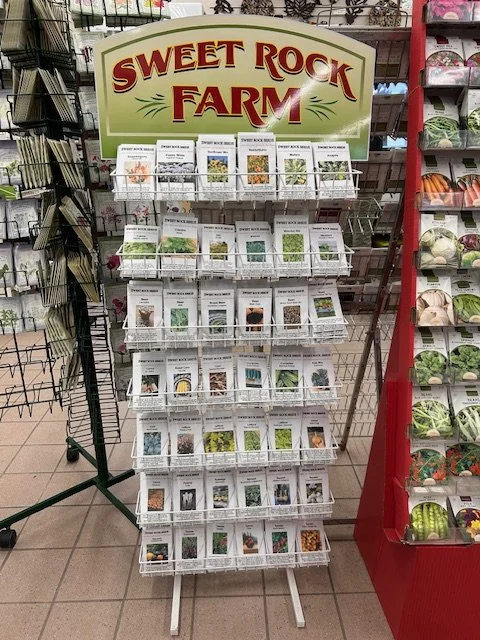
We’re all set up at Dinter’s Nursery in Duncan, so if you’re close by or passing through check it out. It’s a great place to shop!