Spotlight on a Different Winter Green
Hi folks, Happy New Year to all, and best wishes for a bountiful gardening year. To assist in this, we are going to highlight some of our varieties that shine at certain times of the year.
For example, right now in the garden there is a green that is just crushing it! No, it is not kale— although it is doing well and we harvest it regularly. What I would like to showcase here is a variety of Chinese Cabbage called China Choy— a large type of Boy Choy that we grow all through the year for its great taste, quick growth, and stellar hardiness. Here is a quick pic from our website, but I will show a video at the end with plants in the field right now.

As you can see, it is very pretty. It is also super versatile in the kitchen too. We use it in all kinds of stir fries. The stems are sweet and crunchy and can be eaten raw like celery, but the greens benefit from a bit of cooking. I know some people eat it raw, but we don’t.
Another way we eat China Choy is made into Kimchi. What is Kimchi? It is a traditional Korean dish made usually from Napa Cabbage and other vegetables. China Choy is a great substitute: It is waaaay easier to grow, and tastes great in kimchi. And the great thing is, there are literally hundreds of ways to make it, which means there is no right way. I made a perfectly tasty version my very first time (meaning my kids ate it, who have plenty of experience with my experiments and don’t eat anything funky).
As for growing China Choy, if you can grow kale or turnips you can grow this. We start it inside and transplant it out, either in a greenhouse or in the field, depending on the time of year. So many critters like to eat baby brassicas that we have found the best success with transplanting over direct seeding. Once transplanted (at a couple of inches high), we usually cover them with row cover— again, to keep away pests— until they are several inches high and can fend off any predation. This may not be necessary where you live, I don’t know.
They can be eaten at any stage by snipping off leaves as needed, or you can harvest the whole plant at once, when it’s full sized. Here is a short video of plants growing outside now but under under a cover (we often grow our winter veggies like this, under some sort of cover. It doesn’t need to be grandiose either Anything that sheds the snow will do. They will survive without it, but they end up with much more damage from the snow.)
I hope you have a better idea of the potential of China Choy in your garden. It is also equally at home in the summer garden.
Until next time, all the best.
Sal from Sweet Rock Farm Seeds
Seed Growing in a Weird Climate
I get asked all of the time what its like to “grow seeds”, and lately, what it is like to grow seeds with all of the weird weather we have been getting.
The short answer is, increasingly difficult. It seems like every year we get some kind of record breaking weather event. Just in the last 18 months we have had a heat dome, and then a record breaking flood event last November. We followed with a long, wet, cold winter/spring that didn’t warm up until early July. And most recently, the warmest, driest October on record.
I know these weather events are hard on all farmers, whether he/she is a grape grower for wine, a Farmer’s Market vegetable grower (which we also do), or a cattle farmer.
Remember when the heat dome hit us in June 2021? In the course of one day it went from the low twenty’s to the high thirty’s, and over four days got to 40 degrees celsius! I had about two acres of seed crops and vegetables for the market growing and it was very interesting to see what was affected and what soldiered through.
Without exception, all of our “temperate” crops suffered and some failed to give a harvest at all. For example, I had a large planting of beets being grown out for seed, and the sun literally cooked the seeds black on the plants. I wish I had a picture to show but I don’t. Some of the seeds still looked good, so it became a real chore to separate the “cooked” seeds out from the good seeds.
Our onions mostly failed to make large bulbs. They remained permanently shocked by the weather, as did our potatoes. We had a poor harvest of little spuds last year. If we had an unlimited supply of water we would have been able to cool the vegetables through the event, but here on the Gulf Islands water (lack of it) is constantly an issue from late Spring to late Fall. All of the lettuces, both for seed and for market just… quit. We planted more for the market and that was fine but it was too late to start lettuce for seed as it needs a long season to grow and ripen the seeds. Generally, the temperate crops either quit, or slowed way down. Either way, our seed harvests were really low from these crops.
The heat loving crops had various responses: the sweet potatoes loved it! We had a stellar crop of sweeties last year; in fact, the best ever. Believe it or not, this was from one sweet potato plant.

The tomatoes dropped all of their flowers in the heat, but pushed through and produced more flowers soon after and did well otherwise. Peppers were unaffected, likewise cucumbers. Our corn was tasselling during the heat wave and I think the pollen was affected by it because we had a less than stellar (crappy) harvest of corn.
What about that crazy atmospheric river that flooded out much of the lower province? At our place we were anywhere from ankle to knee deep in water, and it stayed that way for three weeks. Being November all of our crops were harvested, but we did have garlic, kale, and turnips in the fields. I thought they were doomed, but amazingly they all without exception did well. Go figure.
Rain in the winter is okay for us, but rain during the growing season— too much at least— is terrible. That is what we endured this Spring. We had January/February weather all the way until July. I thought the seed growing year was going to be a washout and I didn’t even plant some crops. Dried beans, a staple of my business and our household didn’t get planted this year because I thought there wouldn’t be enough time to grow them out and get them to the drying stage before the fall rains started. If only I had a looking glass into the future and saw that we would have the hottest, driest October ever I would have sowed them for sure, but alas!
This is what it is like now. I find myself wondering if we will be on the receiving end of some new record breaking weather event, and I try to plan for… something. We bought a new greenhouse to have more area that is “controllable”. We can plant a crop inside if the weather is too cold or wet and still get a harvest. Or, we can harvest an outside seed crop like dried beans if it looks like we are going to get a freaky rain event and finish drying them inside. Basically it gives us more control.
We also put in drainage around a field to help move the water better in case we get more rain events like last November.
Most of all, we are realizing that diversity is the key to dealing with wacky weather. Diversity is the Key. During these several weather events we had some losses, sure, but we also had successes too, and that is because we are growing dozens of varieties of fruits and vegetables. This super warm, dry October was the tail end of a four month drought, and I know that the forests and grasses, bugs and birds wanted rain, yet it was a blessing to many farmers who had seeds to dry, or squash to ripen, or grapes to ripen enough to use for wine. If not for the warm October, many of us farmers would have had a terrible year because of the late, cold spring.
I’m a glass half full kind of guy, or at least I try to be. This weird weather is making all of us farmers better at our jobs, because we have to be. The weather is gonna do what weather does and we will adapt. For several thousand years of farming, humans have dealt with all sorts of weather, and we are still here. That is something to chew on. Best of the day to you.

Fall Musings
Finally, I feel like things are starting to slow down at the farm. As usual, the year has been super busy and chaotic, starting with frenetic seed sales at the beginning of the year— online and at Seedy Saturdays. By late January, we were starting our first seedlings inside to transplant into our greenhouses and things just kept escalating from there.
Looking back, I don’t know how we managed. Honestly, this year was a special kind of nuts. In addition the usual farm stuff, we bought and erected a new 50’ greenhouse (love it!), started a kitchen reno (ongoing), painted the outside of the house, had the roof redone (not by me, out of my league), and built a root cellar!
Whew! Needless to say, I didn’t keep all of the balls juggling in the air all of the time. My roadside stand suffered some neglect and I didn’t manage to get to every Farmer’s Market. But you do the best you can do and that’s what we all did.
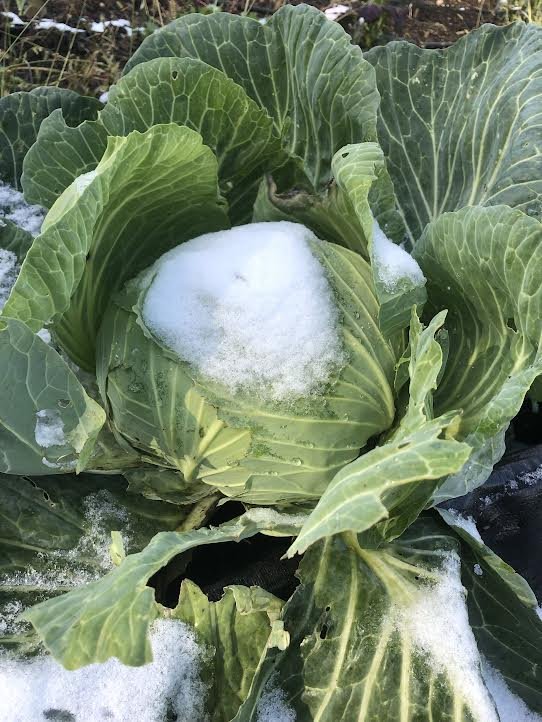
We had lots of successes too. Our late season warm spell was perfect for ripening the last of the seeds in our fields. In fact, all of the fall crops did superbly. It is a good omen for the upcoming seed selling season, I think. I will be sending out an email soon talking about our new seed varieties and a general Hey! Hi! that our website is all updated. If you haven’t signed up for our email list please do. Here’s a picture of our fall cabbages with a light dusting of snow.
All the best of the harvest season to you and yours,
Sal Dominelli
Sweet Rock Farm
Yes It is Time to Plant, Sort Of

When I say it is time to plant I’m saying this with conditions. First, you can start green onions, but not melons. This may be obvious to most of you, but for those of you who are brand new to the gardening world, and the local food movement in general, it is not a given that people know about seasonal eating and growing. I get enough odd questions at the farmer’s market to know this. Like, in mid-May someone will ask, “Do you have any acorn squash?”
Second, to start seeds successfully in early February it sure helps to have a space indoors to start your seeds and have some supplemental lighting unless you have a solarium or serious window light. Your seedlings will otherwise get leggy searching for more light. LED lights are really cheap and will go a long way to making your early gardening season successful. I use these because they can daisy-chain together and can be on the same time. They pay for themselves quickly. Each light will illuminate about 3’x3’.
Finally, a greenhouse or cold frame is needed to really get the seedlings growing well until they can be transplanted outside. They take away the wind and rain, and boost daytime temperatures so that the seedlings grow well. It can be as simple as four two-by-tens nailed into a square with some plastic stapled to the top, leaving some of it unfastened to allow access, or an expensive, full-on, four season greenhouse with roll up sides for ventilation and a door for access.
Why would anyone do this? Isn’t it way more work? Not really. Not much. And don’t you need another hobby anyways? Unless you plan on growing on a commercial scale you only need room for a few flats, about the space of a small table. With this, you can grow vegetables all year round on the West Coast by starting them inside and transplanting them out when they are past the fragile, seedling stage.
With inflation getting worse and driving food prices higher (and everything else!) and supply chain issues creating shortages, it makes sense to get started growing some of your food. Aside from peace of mind, you can’t beat home-grown vegetables for taste, as most of you know.
I have recently started lettuce, spinach, and kale, and will soon start onions, leeks, turnips, Chinese cabbage, radishes, and chard. They all get transplanted outside either to my greenhouse (which is unheated), or straight into prepared ground.
We still have lots of seeds available, with bulk sizes in many varieties, but they are selling fast. Free shipping is available for larger orders. Happy planting! Sweet Rock Farm Seeds Website
Sal Dominelli
Sweet Rock Farm
Seed Saving 101

Love this photo. I grabbed a clump of carrot tops last fall and came up with these beauties. Variety: St. Valery
I recently sat down with Donna Balzer for a conversation about saving seeds, the difference between hybrid and open-pollinated tomatoes, my journey into seed farming, and so much more. We get into best varieties to grow for the home gardener, and why seed saving is so important in these troubled times.
I haven’t done a lot of podcasts (only two), but I really like to listen to them while I am working. Often, while I am filling seed orders or starting seeds I put on a podcast and the work seems to go easier. I will admit that it was kind of weird to listen to my own voice for a change! I hope that this conversation makes whatever you’re doing hum along.. Check it out. https://donnabalzer.com/s2-episode-5-save-seeds-they-will-adapt/
On another note, if you haven’t already started your onions and leeks, now is the time. Onions start to make their bulbs when the summer solstice happens, regardless of their size and leeks take their own damn time to size up, growing slowly but surely through the season. So an earlier start is better for them. If you are motivated and you have the indoor space you can start lettuce, chard, kale, mustard greens, celery, and some others I’ve probably forgotten. It’s almost time to get your peppers and tomatoes going too; at least, if you have indoor lighting and a greenhouse to transplant them into. You will be eating your first tomatoes by late June then. Yum!
Happy planting folks,
Sal Dominelli
Sweet Rock Farm
What Should I Plant Right Now?

Yesterday I was working outside in a t-shirt. It was sunny, not a cloud in the sky, and I could actually feel the warmth of the sun on my face and arms. Today, the temperature will barely crawl above zero, and we had a hard frost last night. For the next several days it is supposed to go down several degrees below zero. This time of year we often get these “extremes”. I like to think that Winter and Spring are battling over who gets control of the weather. Not being a winter person I cheer wholeheartedly for Spring and revel in the warm days and curse when I have to wear layers of clothes to keep warm when I’m working outside.
So in answer to the question of what to plant right now, the answer is not much… unless you have an indoor heated space to start seedlings. Then you can get going with some early stuff. Most market growers will have started their earliest plantings of things like onions, leeks, lettuce greens, and other greens— mostly brassicas like Kale, or any of the mustards. There are a couple of other greens that you can plant early as well. Claytonia, also know as Miner’s Lettuce is great, Corn Salad, and of course, Spinach.
When you start your seedlings inside you also need lights or they will get leggy and fall over from not enough light. I just updated my indoor lighting setup a couple of weeks ago and am so stoked because it was simple and relatively cheap. For too many years I have used fluorescent lights to grow my seedlings, and while it works, I have found them awkward because they have to be placed close to the plants to provide enough light, which makes it difficult to water them properly. Plus, the cost of replacement bulbs has gotten out of control. This year I decided to check out LED lights as they have come down in price so much, and they are cheaper to run than flourescents.
A friend showed me his set up and I was sold (shout out to Grahame W.!). One of these grow lights is enough for a few seedling trays and can be placed high enough over the plants to make for easy watering. In fact, I have placed a layer of plastic down on the table and put a raised ring of wood around the edges of the table so I can bottom water. I recommend this once the seeds have germinated as its quick and the seedlings like it. I don’t need a huge, intensive space to get a head start on everything. Enough to get a dozen trays going is good for me. Then I transfer the cold hardy veg starts to an outdoor greenhouse to harden off until they go into the ground or into another greenhouse for early selling.
If I wasn’t a market grower, trying to be first to have that salad mix ready, or trying to have the biggest sweet onions I wouldn’t be so quick to start things. As a home grower there is not much advantage in being the first in your hood to have lettuce. It is a lot of extra effort and if you wait just a few weeks you can have greens almost as early.
I will say that an early start is almost essential for onions and leeks though. They grow slow and steady all through the cold wet spring and really appreciate the long growing period. After the summer Solstice they stop putting out leaves so much and concentrate on bulbing, so the bigger the plant by then, the bigger the bulb. Leeks just keep slowly growing all season long.
If you haven’t started your onions yet, for sure get them going. Even without indoor lights, you can put them on a bright windowsill until they can be transplanted outside. You will be rewarded with bigger bulbs come August.
Seed Matters

Ethiopian Blue Tinge Wheat. This variety can be easily grown, then cooked and eaten like rice!
Hi Folks. The weather here on Gabriola Island is rain mixed with the barest tinge of sleet; in other words, it is an inside day. The animals think so too. They are inside their shelters munching contentedly on hay, not even curious about venturing out of doors.
If you have recently perused the online catalogs of the big seed companies you will have noticed that backlogs are already starting to happen. Because of the pandemic last year, there was a buying panic on vegetable seeds, which caused huge wait times for shipping, and some companies flat out stopped selling to home gardeners (Johnny’s Seeds).
Well, the pandemic is still here and it looks like there is a continuing fervor around all things seeds. We are certainly noticing it here at Sweet Rock Farm. I have a request of ya’ll, those of you who garden and grow our seeds or anyone else’s. This year, when you plan your garden and you are dreaming of plucking ripe tomatoes off the vine, or harvesting that huge broccoli crown you just know you can grow, this year plan to save some seeds. Nothing crazy, something easy like beans or peas to start with. Why?
Seed Matters. Seeds matter. They are the base of our entire food chain and in all cultures, across all of the time that we have practiced agriculture, seeds have been cherished, grown, traded, and given as gifts. In North America, even 75 years ago it was the usual practice to save your own seed from year to year, as a farmer or gardener. Its not that hard, all it takes is intent. There is a ton of information online about saving seed if you are not sure. It just takes you to do it.
This may seem self defeating at first. After all, it is in my interest as a seed producer to have you come back year after year to buy my seed. But its not, not really. it is really difficult to produce all of one’s own seed, just as it is very hard to grow all of one’s food. So you’ll keep coming around (I hope!).
What this is about is relocalizing our food web. The pandemic has shown us that our globalized food chains are brittle, and in fact, are quite fragile. We need to start producing more of our own food. In Canada, in BC, and in our own cities and locales. And this begins with seed. Which begins with you.
Like I said above, it doesn’t have to be a huge ordeal. The lettuce seed you save from your best two or three lettuces would be enough for a couple years of harvests. If we all do this, we become stronger together as a community and a nation.
Have a great gardening year everyone,
Sal Dominelli
Sweet Rock Farm Seeds
Happy New Year!

Kabuli Chick Peas. Easy to grow and super productive.
Its a brand new year, and despite our fields being completely flooded because of this incessant rain, I am in a pretty positive space. I was going to write today about the politics of seeds and why it is so important to support small scale seed producers (like us!), but meh.
I’m way too excited about the upcoming season and crop planning. This is the part of the year that everything is perfect because my plans are all down on paper or in my head and I haven’t screwed anything up yet. Its all good!
For example, for one bed in one of my greenhouses I have written down that I am to start spinach by January 15th inside under lights to be ready to transplant as soon as they are ready. The bed will be all amended with compost and a light dusting of oyster shell, and I will be able to plop them right in. Once I have harvested them several times and they are starting to bolt, I will have a bunch of cucumbers ready to transplant in where I will have hoed through the spinach. They will be left in place to provide a mulch and to decompose. I will also have lettuce transplants ready to put in beside the cucumbers, a row on either side of the cucumbers at the edge of the bed to utilize the entire bed while the cukes are still small.
Once the cucumbers are finished (and these are cucumbers grown for both harvesting fresh and for seed) in September/ October, I will “clean up” the bed by cutting off the cucumber stems at soil level and sprinkling some more compost. I will then transplant more lettuces into the bed for a final crop.
Will this work? I have done this before but it never works exactly to plan. Sometimes I fall behind in the weeding so things are a mess, or the spinach bolts too early before the cucumbers are ready, or its still too cold at night to put the cukes in. Anything can happen, and something usually does to keep things less than perfect.
But right now, on paper and in my head, the year will run smooth like a well oiled machine.